The Label Trick: What Your Dog's Food Isn't Telling You
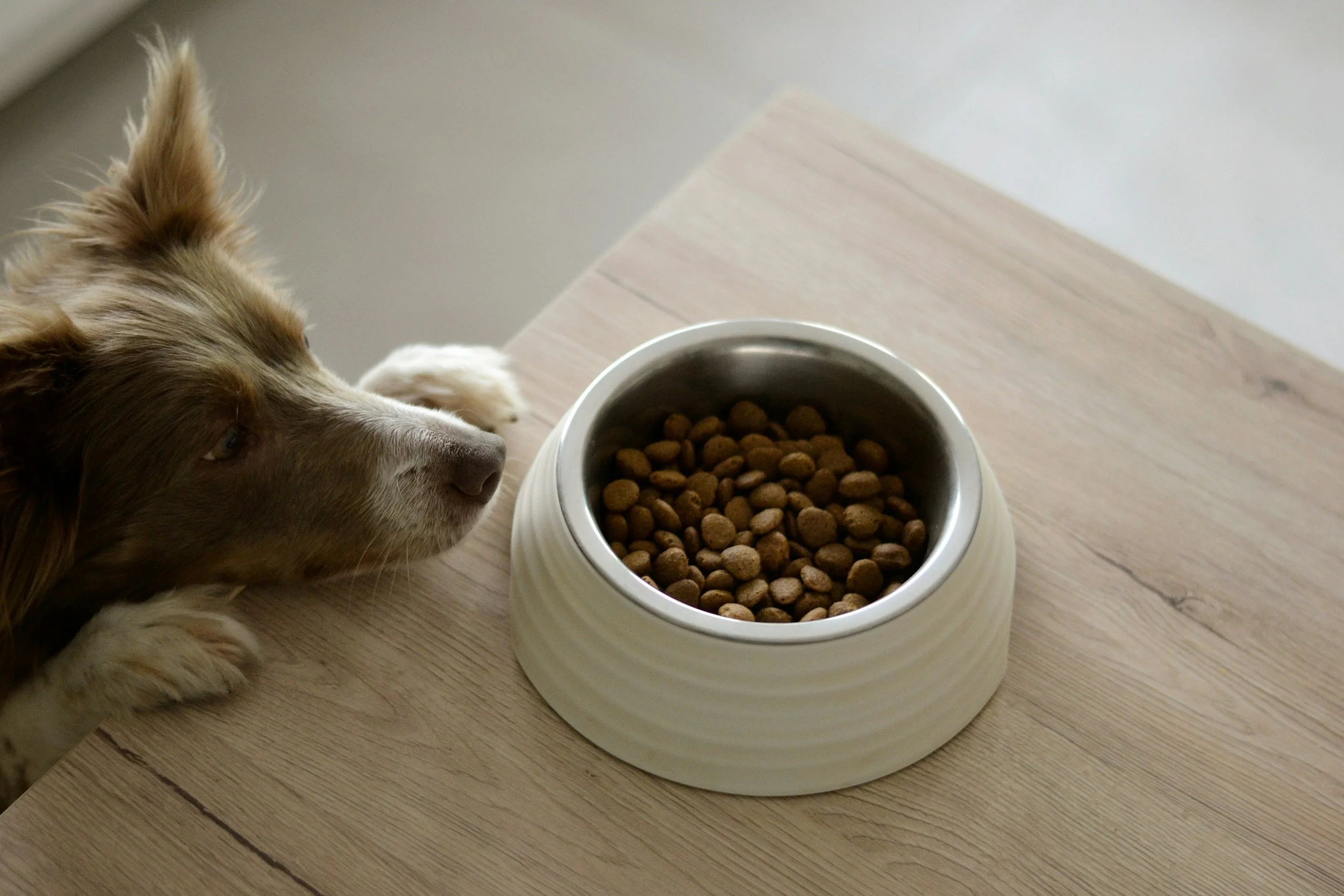
Turn over a bag of kibble and read the ingredients. If you're not sure what half of them are, you're not alone - and that's exactly where this conversation needs to start. It lines every supermarket shelf. It's been marketed as complete, balanced and convenient for decades. But how much do you actually know about what goes into that bag - and what happens to those ingredients before your dog eats them?
Let's start with something the pet food industry would rather you didn't dwell on: the majority of dry kibble sold is manufactured to a price point, not a nutritional standard. That doesn't mean all kibble is terrible - but it does mean most of it falls significantly short of what a dog's body actually needs to thrive. Understanding why starts with understanding what kibble actually is, how it's made, and what those ingredient lists are really telling you.
What Kibble Actually Is
At its most basic, dry kibble is a mixture of ingredients cooked under intense heat and pressure, shaped into uniform pieces, and dried until shelf-stable. It's been sold to us as a single product providing complete nutrition in a convenient format - and for millions of dogs, it forms the entirety of their diet, day in and day out, for years. When you actually stop and think about it, feeding a living creature the exact same thing, meal after meal, for their entire life, isn't something I’d choose for my own dogs, or ask of any other family member - yet it's become so normalised for dogs that its rarely questioned. And even setting that aside, there's a second issue: what actually goes into that bag in the first place, and what happens to it during processing.
Worth knowing: UK pet food is governed by EU-derived feed legislation, which allows ingredients to be listed in broad, vague categories - "meat and animal derivatives," for instance, without specifying species, quality, or exact percentage. This gives manufacturers enormous flexibility to swap ingredients batch to batch based on whatever's cheapest at the time.
How Kibble Is Made: The Extrusion Process
Almost all dry kibble is made using extrusion - the same industrial process used to make breakfast cereal and puffed snacks.
Dry ingredients are mixed - grains, cereals, dried meat meals and other dry components blended together.
Wet ingredients are added - fats, fresh or frozen meat (if used), and water, until the mixture resembles a thick dough.
The extruder cooks and shapes the mix - forced through a machine at 120-160°C under high pressure, puffing up as it exits and cut into the uniform nuggets we recognise.
Drying and coating - dried in an oven to remove moisture, then coated with fats, palatability enhancers, and synthetic vitamins and minerals sprayed onto the outside. These coatings are what make dogs want to eat the kibble - and what attempt to replace much of the nutritional damage done by the cooking process.
Extreme temperatures destroy or degrade a significant portion of naturally occurring vitamins, enzymes and beneficial compounds. Vitamin C and B vitamins are particularly heat-sensitive, and proteins are denatured, affecting digestibility. This is precisely why synthetic nutrients have to be sprayed back on afterwards - and why the quality of those synthetics, and whether they're in bioavailable forms, matters enormously.
What's Actually Inside Most Kibble
Ingredient lists must be listed in descending order of weight before processing, which sounds helpful, but a handful of common practices make it easy to mislead without technically lying.
Meat and animal derivatives: a catch-all term that can legally include beaks, feathers, hooves and intestines. Species and quality can change batch to batch without notice. Avoid.
Cereals: another vague umbrella. Could be wheat, corn, rice or barley, or a rotating blend. Treat with caution.
Chicken (30%): a named protein with a declared percentage. This is what transparency looks like. A good sign.
Chicken meal: rendered, dried chicken. Not inherently bad, and actually higher in protein by weight than fresh chicken (around 70% water). The quality of the source matters. Check the context.
Maize / corn syrup: a high-glycaemic carbohydrate with minimal nutritional value for dogs. Often a cheap filler. Avoid.
Derivatives of vegetable origin: plant matter of unspecified origin and quality. Avoid.
Sugar or caramel: added purely for palatability. No nutritional benefit, contributes to dental problems and blood sugar instability. Avoid.
Vitamins and minerals (listed individually): synthetic supplementation added back after processing. Better when individually named, "vitamin E supplement" is more reassuring than a blanket "vitamins." Check what's listed.
The ingredient-splitting trick: because ingredients are listed by weight, a manufacturer can split a single base ingredient say, rice into "rice," "rice flour" and "rice bran" separately. Listed individually, each appears lower down the list. Combined, they might outweigh the meat content entirely. Always look at the full picture, not just what's sitting at the top.
Why so many carbs? Dogs aren't grain-intolerant by default, and carbohydrates in reasonable quantities aren't inherently harmful. But kibble requires a high starch content simply to hold its shape during extrusion, meaning even foods that look meat-heavy on the label may still contain 40–60% carbohydrate, far beyond what a dog's digestive system is optimised to handle. Over a lifetime, high-carbohydrate diets are associated with obesity, dental disease, chronic inflammation and blood sugar dysregulation.
How to Read a Label
Green flags: look for these
A named meat as the first ingredient, ideally with a percentage declared ("chicken 40%")
Recognisable, specific ingredients - "brown rice" rather than "cereals," "dried sweet potato" rather than "vegetables"
Natural preservatives - mixed tocopherols (vitamin E) rather than synthetic chemicals
A short, legible ingredient list - if you can't picture what most ingredients are, that tells you something
Amber flags: proceed with caution
Meat meal - check where it sits and whether the source is named
Multiple forms of the same carbohydrate - likely ingredient splitting; add them up mentally
Estimated carbohydrate over 40% - calculate it yourself: 100% minus declared protein, fat, moisture, ash and fibre. Whatever's left is largely carbohydrate
Red flags: walk away
"Meat and animal derivatives" as the first or second ingredient - the biggest red flag of all
BHA, BHT or ethoxyquin - synthetic preservatives; BHA and BHT are classified as possible carcinogens, and ethoxyquin is banned in human food in the EU
Artificial colours - dogs can't distinguish colours the way we do, so these exist purely to appeal to human buyers
Sugar, caramel or syrups - no place in a dog's food, full stop
"Flavour enhancers" or "palatability improvers" - good ingredients don't need chemical coatings to make a dog want to eat them
So should you ditch kibble entirely? Not necessarily. The goal here isn't to tell you dry food is always wrong, or that every owner needs to switch to raw tomorrow. Life, budget, convenience and individual dog needs all matter. A genuinely good quality kibble, properly chosen, can absolutely form the basis of a healthy diet. What I'm arguing for is informed feeding.
The Tool That Takes the Guesswork Out
Knowing what to avoid only gets you so far, what most owners actually need is a reliable way to assess any food objectively, without a degree in animal nutrition. Fortunately, there's exactly that, and it's free.
All About Dog Food (allaboutdogfood.co.uk) is an independent UK-based website that's been rating and reviewing dog foods for over a decade, no advertising deals, no brand affiliations, purely ingredient quality, nutritional composition and labelling transparency. If you do nothing else after reading this, bookmark it.
Search for any food and read its rating - the higher the score, the better it rates for quality, balance and transparency. Use it as a guide, but always read the full ingredient analysis rather than relying on the number alone.
Read the ingredient analysis - this is where the real value lies. Every ingredient is broken down individually, problem ones flagged in plain English, explaining exactly why something's a concern.
Use the Food Finder if you don't have a specific food in mind - filter by format, protein source, budget and rating.
Compare foods side by side once you've narrowed it down.
A food might rate well overall but have a specific ingredient that doesn't suit your individual dog. Equally, a mid-range scoring food can be a genuinely excellent choice within a tight budget, the site gives you the context to make that call yourself. And ratings can change: manufacturers reformulate quietly, so it's worth rechecking any food you've fed for a while, particularly if you've noticed changes in your dog's coat, digestion or energy.
There's also a common assumption that expensive automatically means good, and cheap automatically means poor. Neither is reliably true. Some well-marketed, premium-priced foods rate surprisingly poorly - the budget has gone into branding rather than ingredients. Equally, some mid-range foods represent outstanding value.
No food rating, however good, overrides knowing your own dog. The best food for your dog is one they genuinely do well on - good coat condition, healthy weight, firm stools, good energy, bright eyes. Use All About Dog Food to build an informed shortlist. Then watch your dog. They'll tell you the rest.