Reading Your Dog's Body Language: A Guide to Calming Signals
I've referenced calming signals a few times across this blog, in posts on bringing a rescue dog home and on choosing the right dog, and it's genuinely one of the most valuable things any dog owner can learn to recognise.
What Calming Signals Actually Are
Calming signals are a specific, catalogued set of behaviours dogs use to communicate, primarily to defuse tension, calm themselves in a stressful situation, or signal peaceful intent to another dog or person. The term, and the framework most trainers and behaviourists now use, comes from Norwegian dog trainer and behaviourist Turid Rugaas, who spent years studying and documenting these behaviours, eventually identifying around 30 distinct signals in her book, On Talking Terms With Dogs: Calming Signals.
This is worth distinguishing from "body language" as a vague, general concept. Calming signals are specific, identifiable behaviours with a genuine communicative function, not just incidental movement. Once you learn to recognise them, you start seeing your dog communicating constantly, in situations you may previously have read as neutral, or missed entirely.
Why This Matters So Much
The honest, somewhat uncomfortable truth is that most conflict between dogs and humans, and a significant proportion of dog bites, happen not because a dog "suddenly" reacted without warning, but because a series of calming signals were given, missed or ignored, before the dog escalated to something more obvious. A dog rarely goes from completely relaxed to a growl or a snap in a single step. There's almost always a build-up, and calming signals are very often that build-up, quiet, easily missed communication that a dog is uncomfortable, before they feel the need to communicate it more forcefully.
Learning to spot these signals isn't just intellectually interesting, it's one of the single most practical things you can do to prevent conflict, reduce your dog's stress, and build genuine trust, since responding appropriately tells your dog their communication actually works, which makes them less likely to need to escalate to get heard.
The Signals Themselves
There are far too many catalogued signals to cover exhaustively in one post, but here are some of the most common and most useful to learn to recognise.
Lip licking: A quick flick of the tongue over the lips or nose, often mistaken for anticipation of food, but frequently a genuine stress or discomfort signal, particularly when it happens outside of any food context, during a vet exam, when approached by a stranger, when another dog gets too close.
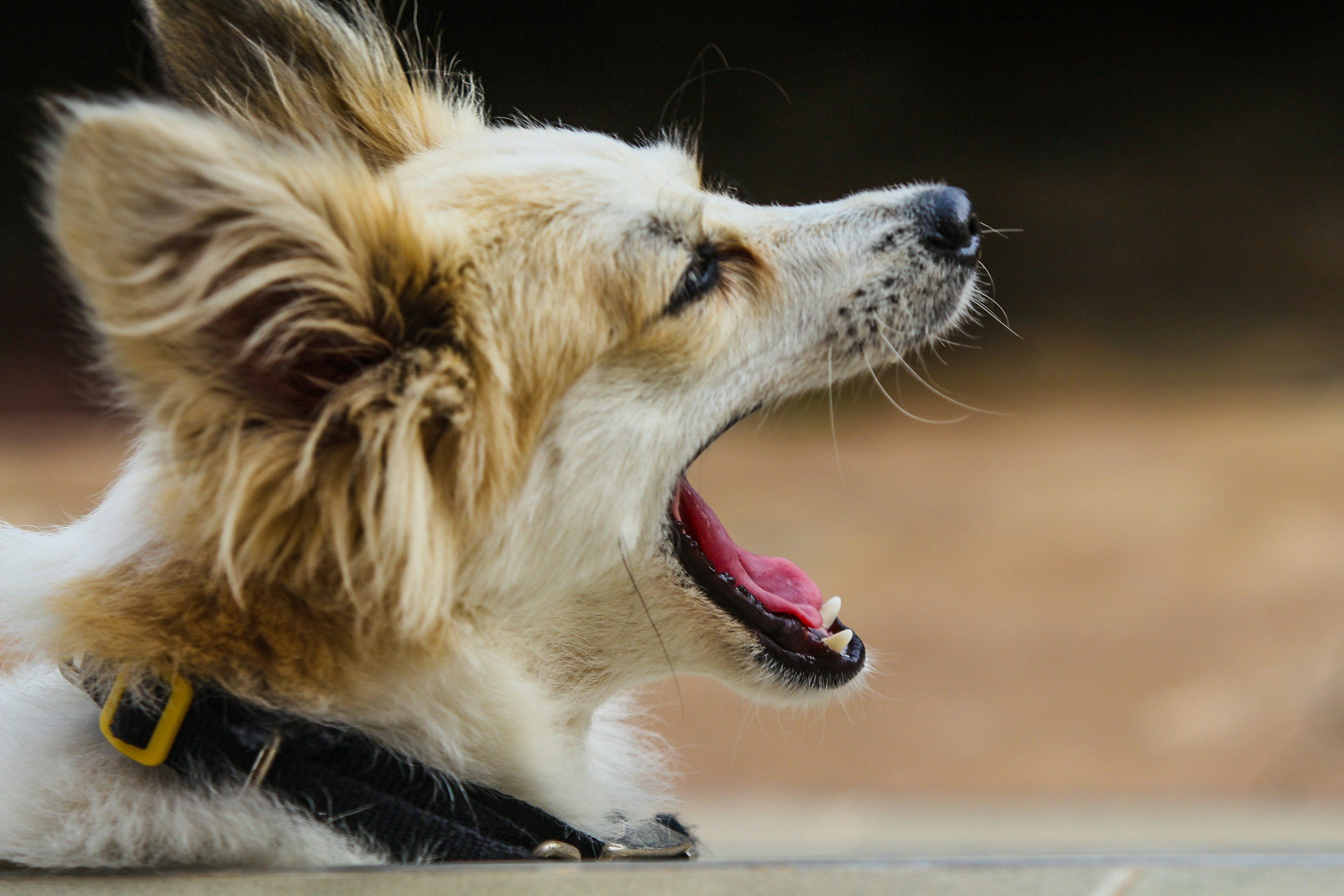
Yawning: Like lip licking, easily misread. A dog yawning when they're clearly not tired, in a stressful situation, during training, when meeting a new person, is very often communicating stress or mild anxiety rather than tiredness.
Turning the head or body away: A dog looking away, or turning their whole body slightly away from something, whether another dog, a person, or a direct approach, is a genuine calming signal, an attempt to defuse a situation by reducing direct confrontation. This is often missed entirely, since it's such a subtle movement.
The curved approach: Watch two comfortable, well-socialised dogs greet each other and you'll rarely see a direct, head-on approach, they'll naturally curve toward each other in an arc. A dog approaching another dog head-on, particularly at speed, can read as confrontational, and a dog who curves their approach is actively signalling peaceful intent.
Freezing: A dog going completely still, sometimes with a lowered head or stiffened body, is a significant signal worth taking seriously, often indicating the dog is genuinely uncomfortable and close to their threshold. This is one of the most important signals to learn to spot early, since it frequently precedes a more obvious reaction if the situation isn't defused.
Whale eye: When a dog turns their head away slightly but keeps their eyes on whatever's concerning them, showing the whites of their eyes in a crescent shape. A clear, specific sign of discomfort or mild fear, commonly seen when a dog is guarding something, feeling cornered, or unsure about handling.
Shake-offs: The full-body shake dogs do, the same movement as shaking off water, but happening on a completely dry dog, often immediately after a stressful interaction or a moment of tension. This is a genuine stress-release behaviour, worth watching for after any interaction that might have been a little much for your dog, a boisterous greeting, a slightly too-enthusiastic child, an overwhelming vet visit.
Sniffing the ground: Sudden, apparently random ground-sniffing, particularly when it interrupts another activity or happens when another dog or person approaches, can be a calming signal rather than genuine interest in a scent, a way of disengaging from a situation that feels slightly too much.
Slow movement and soft blinking: Deliberately slow, calm movement, and soft, slow blinking rather than a hard stare, are both signals a dog uses to communicate calm, non-threatening intent, and are also genuinely useful signals for a human to consciously use back, moving slowly and blinking softly around an anxious or unfamiliar dog can help communicate the same message.
The play bow, used outside of play: Most owners know the play bow, front end down, rear end up, as an invitation to play. Less well known is that dogs sometimes use this same posture outside of an obvious play context, as a way of diffusing tension or signalling friendly intent in a slightly uncertain interaction.
Context Changes Everything
None of these signals mean the same thing in every situation, and this is genuinely important to understand rather than treating this as a fixed dictionary. A yawn during a calm, restful evening at home is very likely just a yawn. The same yawn during a nail trim, or when a strange dog approaches on a walk, is a different signal entirely. Reading calming signals well means reading them in context, alongside the rest of your dog's body, their overall posture, their tail, their ears, rather than fixating on a single signal in isolation.
When Signals Are Harder to Give or Read
Worth knowing, and genuinely relevant to welfare rather than just an interesting aside, some dogs are physically limited in their ability to give or show these signals clearly, through no fault of their own.
Docked tails remove a huge amount of communicative range. Tail position, height, speed and stiffness all carry meaning, a docked dog has lost a significant part of their communicative toolkit entirely.
Cropped ears work similarly, natural ear position and movement, forward, back, flattened, are a major part of how dogs signal, and cropping limits this considerably.
Brachycephalic, flat-faced breeds, French Bulldogs, Pugs, and similar, often have a reduced ability to show some of the subtler facial signals, a soft, relaxed mouth or a clear lip lick can be genuinely harder to read given their facial structure, even though the underlying communication is very likely still happening.
Heavily coated or very fluffy-tailed breeds can have their body language physically obscured, a tucked or lowered tail is much harder to spot under a thick, fluffy coat than on a short-haired dog.
How to Respond
Spotting a signal is only half the picture, what you do next matters just as much.
Give space, don't push through: If your dog shows a calming signal, a freeze, a turn away, a lip lick, during an interaction, the appropriate response is almost always to slow down, back off slightly, or pause, rather than continuing on the assumption that everything's fine because nothing more dramatic has happened yet.
Don't force continued exposure: If a dog is showing repeated signals during, say, a greeting with another dog or a new person, ending the interaction rather than insisting they "just need to get used to it" respects what they're actually communicating, and prevents them needing to escalate to be heard.
Use calming signals back: Slow movement, avoiding direct eye contact, turning your body slightly away rather than facing a nervous dog head-on, curving your approach rather than walking straight at them, these are things you can consciously do to communicate the same calm, non-threatening intent a dog would communicate to another dog.
Common Misreadings
A few frequent ways these signals get missed or misunderstood, worth knowing specifically.
"He's just excited," when a dog is actually stressed: Panting, general activity and movement can look like excitement when it's actually a stress response, particularly in a dog who's naturally more anxious or hasn't learned other ways to communicate discomfort.
Missing the early signals and only noticing the escalation: A growl or a snap can feel like it came "out of nowhere," but very often a string of quieter signals, a freeze, a lip lick, a turned head, preceded it by several seconds or longer, simply unnoticed. Learning to catch the early, subtle signals means you rarely need to deal with the more dramatic escalation at all.
Punishing the growl: Worth a specific mention, since it's a genuinely common and genuinely harmful mistake. A growl is itself a calming signal, or at least a clear communication, a dog telling you plainly they're uncomfortable and need space. Punishing a growl doesn't remove the underlying discomfort, it just teaches a dog that communicating their discomfort leads to punishment, which can result in a dog who skips the warning altogether next time.
Calming Signals Between Dogs
Everything covered so far applies just as much, arguably more, to how dogs communicate with each other, not just with humans. Understanding these signals helps enormously when reading a greeting between two dogs, is that curved, relaxed approach a good sign, or is one dog freezing and giving whale eye while the other continues to push in? Being able to read this in real time is one of the most useful skills for safely managing introductions, dog park visits, or any situation where dogs are meeting, since you can step in and create space before a subtle signal becomes a real conflict.
Start Small
You don't need to memorise all thirty catalogued signals to get real benefit from this. Picking two or three, the yawn, the lip lick, and the freeze are a genuinely useful starting trio, and simply paying closer attention to your own dog for a week or two will very likely reveal communication you've been missing all along. Once you start seeing it, you generally can't stop, and your dog, quite literally, will thank you for finally listening.